

Arthur Streeton was one of Australia’s most celebrated landscape painters and a defining figure of the Heidelberg School. Born in Victoria and trained at Melbourne’s National Gallery School, he helped shape a new way of seeing the Australian landscape through light, colour, and atmosphere.
In this article, we’ll look at how Streeton’s early life, his role in Australian Impressionism, and his connection to Eaglemont and Banyule helped make him one of the most important Australian landscape artists in the country’s history. We’ll also explore why Arthur Streeton remains such an influential name in Australian art today.
Early Life and Artistic Beginnings Arthur Streeton is one of the most important Australian landscape artists of the late 19th and early 20th centuries. Born in 1867 and raised in Victoria, he showed an early talent for drawing and began formal study at Melbourne’s National Gallery School, where he trained in the evenings while also working to support himself. Those early years gave him both technical discipline and a strong interest in painting outdoors, which later became central to his style as an artist and a leading painter of landscape art.
Streeton’s exposure to Australian impressionism helped shape his approach to colour, light, and atmosphere. Rather than copying European models, he began looking closely at the Australian environment around him, laying the groundwork for the style that would make Arthur Streeton a defining figure in Australian art.
The Heidelberg School and Australian Impressionism
Emerging in the northern suburbs of Melbourne in the 1880s and 1890s, the Heidelberg school consisted of a group of painters who would paint outdoors. It is now recognised as one of the most important Australian art movements and became the foundation of Australian Impressionism.
Streeton was at the centre of the group alongside Tom Roberts, Frederick McCubbin, and Charles Conder. Together, they pushed Australian painting away from imported European conventions and toward a distinctly local vision, helping establish a new visual language for the bush, the suburbs, and the changing light of the continent.
Eaglemont and Golden Summer
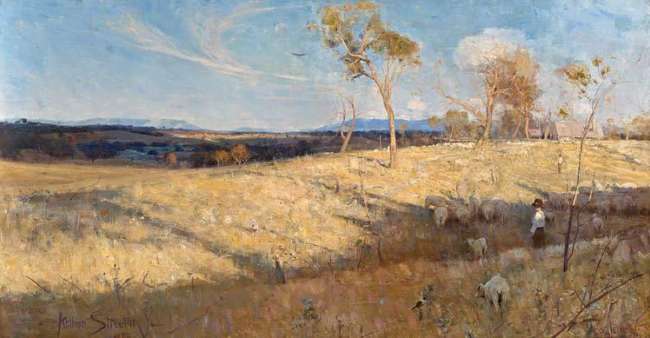
Eaglemont was one of the most important creative sites in Streeton’s career. In the late 1880s, he worked there in an artists’ camp, surrounded by the bushland and open views that would inspire some of his most famous work. It was here that he painted Golden Summer, Eaglemont (1889), a masterpiece that captures the heat, distance, and golden light of the Australian landscape in a way that felt entirely new.
For readers in Banyule and Ivanhoe, that history still feels close to home. Eaglemont remains part of the local story, and the landscape that inspired Streeton is still visible in the contours, streets, and bush reserves that shape the area today. As a long‑standing Banyule property specialist, Miles Real Estate understands how strongly this artistic heritage is connected to the character of the neighbourhood.
International Recognition and Time in Europe
Streeton’s success didn’t stop at home. Golden Summer, Eaglemont became the first work by an Australian‑born artist to be exhibited at London’s Royal Academy, giving him rare international recognition at a young age. He later spent time in Europe and exhibited again at the Royal Academy, but while his reputation in Australia was already secure, his reception in the UK was more mixed.
That difference says a lot about the era. In Australia, Streeton was celebrated as a painter who understood the local landscape in a way few others did, while in Britain he was often seen through a more traditional European lens that didn’t always embrace his bright, sun‑drenched style.
Legacy
Today, Streeton is regarded as one of the great Australian landscape painters, and his works are among the most valuable in the country. Paintings like Golden Summer, Eaglemont are prized not just for their beauty, but because they helped define how Australians see their own land and history.
His legacy also lives on through the broader influence he had on later generations of Australian landscape artists and through the enduring popularity of the Heidelberg School. More than a century later, artist Streeton remains a name closely linked with Australian identity, artistic innovation, and the story of Melbourne’s north‑east.
If you’re considering a move to the Banyule region, you can browse our latest property listings or explore what makes Banyule’s suburbs so desirable. Get in touch with Miles Real Estate, the Banyule real estate experts since 1924.
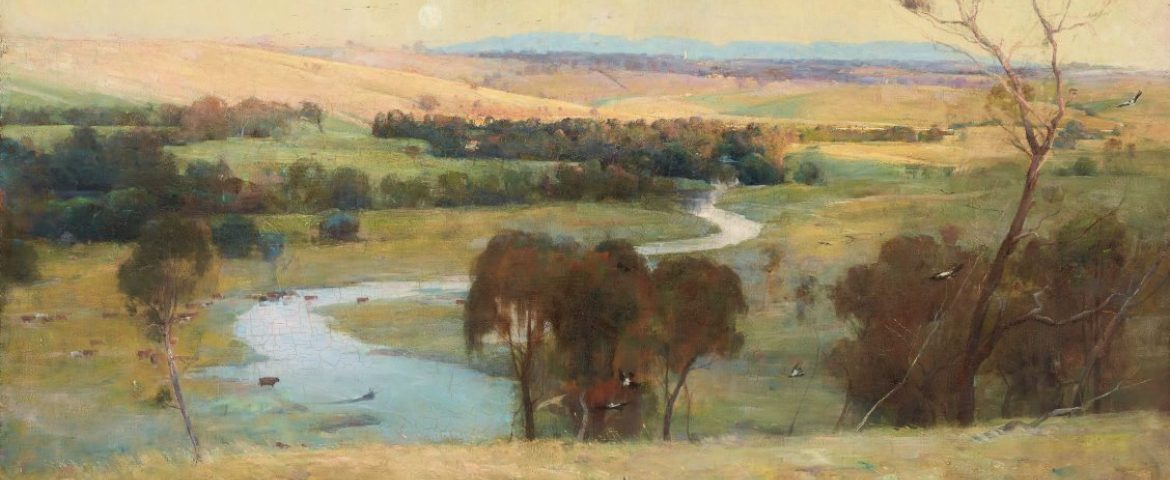
Hero Image: Still glides the stream, and shall for ever glide′ (1890) by Arthur Streeton