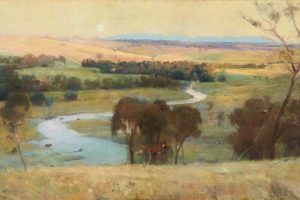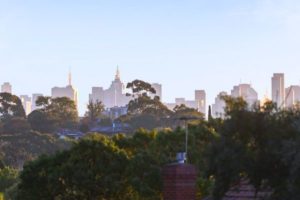


Nestled in the leafy suburbs of Melbourne’s north‑east, the story of the Heidelberg School is more than just art history, it’s part of the very landscape of Banyule. In the late 1880s and 1890s, a group of pioneering Australian impressionist painters began camping along the Yarra River, in Heidelberg and Eaglemont, and set about capturing the Australian bush in a way no one had done before. Their work would go on to define Australian impressionism and become one of the country’s most important Australian art movements.
Today, those same streets, riverbanks, and bush reserves still echo in the brushstrokes of classic Heidelberg‑era paintings, weaving art and everyday life together in suburbs like Ivanhoe and Heidelberg. For anyone living or investing in Banyule, understanding the Heidelberg School gives a deeper appreciation of the character, history, and atmosphere that make this part of Melbourne so special.
What was the Heidelberg School?
Emerging in the late 1880s and flourishing through the 1890s, the Heidelberg School was Australia’s first truly distinct artistic movement, centred on the bush and suburbs to the east of Melbourne. Often described as Australian impressionism, it broke away from European‑style studio painting and instead celebrated the Australian landscape in its raw, sun‑drenched form.
The name “Heidelberg School” comes from the Melbourne suburb of Heidelberg, where a group of artists set up makeshift camps and painted outdoors together. In 1891, American critic Sidney Dickinson coined the term after seeing their work, and the label stuck helping to cement the Heidelberg School as one of the most important Australian art movements in history.
Artists who defined the movement
The Heidelberg School was built around a core group of Australian impressionist painters who shared a passion for capturing everyday Australian life. Each brought a slightly different style, but together they shaped the look and feel of early Australian impressionism.
- Tom Roberts – Often called the “leader” of the group, Roberts brought European impressionist techniques back to Australia and pushed his peers to paint light and colour directly from life.
- Arthur Streeton – Best known for his vivid, sun‑baked landscapes, Streeton’s work captured the intense heat and huge skies of the Australian bush like few others.
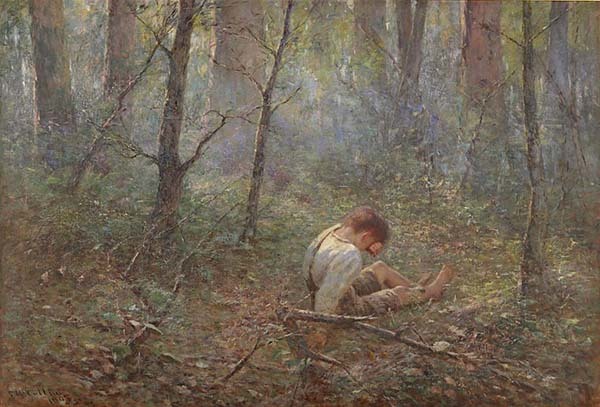
- Frederick McCubbin – McCubbin focused on the emotional connection between people and the bush, telling stories through intimate scenes of bush workers and settlers.
- Charles Conder – Conder brought a more lyrical, decorative touch, blending European elegance with Australian motifs and helping to soften the rawness of the wild landscape.
- Walter Withers – Withers specialised in quieter, more atmospheric bush scenes, often of the Heidelberg and Eaglemont areas, giving the movement a sense of stillness and poetry.
Painting the Australian landscape
What made the Heidelberg School so revolutionary was the way it portrayed Australian light, heat, and scale. Before this, many Australian landscapes were filtered through European ideals, tidy, pastoral, and almost “tame”. The Heidelberg artists turned that around, using bold brushwork and bright, accurate colour to show the bush as it really looked: vast, shimmering, and sometimes harsh.
They also embraced plein‑air painting, working outdoors with their canvases set up next to the scene. This meant they could capture the changing light and atmosphere in real time, instead of recreating it from memory in a studio. At a time when Australia was still feeling its way toward a national identity, this shift toward distinctly Australian realism helped Australians see their own country in a new light.
The importance of Heidelberg and Eaglemont
Heidelberg and Eaglemont became the heartland of the Heidelberg School because they offered easy access to the bush while still being close to Melbourne. The artists camped in bush huts, backyard studios, and borrowed farmhouses, using the area’s river flats, gullies, and gum trees as their living subject matter. The arrival of the steam train and tram lines made it simple for city‑based artists to travel to and from these eastern suburbs, so Heidelberg and Eaglemont naturally became the base for the movement.
Today, streets around Studley Park, Eaglemont Heights, and nearby river‑side paths still echo the landscapes seen in classic Heidelberg‑era works. The Heidelberg Artists Trail threads through Banyule, Eaglemont, and beyond, guiding visitors past the exact spots where Tom Roberts, Arthur Streeton, and Walter Withers painted some of their most famous scenes.
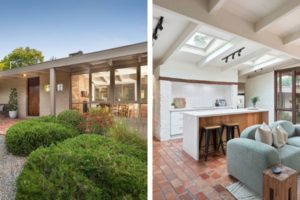
As a long‑standing specialist in Banyule property, Miles Real Estate understands how deeply this artistic heritage is woven into the fabric of today’s suburbs. For those who live in Ivanhoe, Heidelberg, or the wider Banyule region, there’s a unique sense of walking in the footsteps of the Heidelberg School whenever you stroll by the Yarra, the bush reserves, or the quiet, tree‑lined streets that inspired so much Australian impressionism.
The Heidelberg School’s lasting legacy
The Heidelberg School did more than just redefine Australian landscape painting. It helped shape a sense of Australian national identity. By showing the bush as a place of beauty, drama, and everyday life, the Australian impressionist painters of this movement gave Australians a visual language for their own country.
Its influence can be seen in generations of later Australian artists, from the war‑era realists to contemporary landscape painters who still grapple with how to portray the unique light and emptiness of the Australian sky. Today, works by the Heidelberg School regularly fetch record prices at auctions, underlining how highly regarded these early Australian art movements have become in the broader art world.
Exploring the Heidelberg School today
If you’re curious about the Heidelberg School and how it shaped Melbourne’s artistic history, one of the best ways to experience it is the Heidelberg School Artists Trail. Stretching about 40 kilometres through the “Valley of the Arts”, the trail passes through Banyule, Eaglemont, and surrounding municipalities, with 57 signs showing reproductions and stories of key paintings in the exact or near‑exact locations where they were created.
Walking or cycling the trail gives you a real‑time sense of the light and scenery that inspired these artists, making it both a cultural and scenic experience.
Interested in living in the Banyule region, see our current listing of properties for sale or read more about suburbs of Banyule? Contact Miles Real Estate, your Banyule property specialist, and discover how this rich artistic legacy continues to shape the lifestyle and character of Heidelberg, Ivanhoe, and the wider Banyule region.